


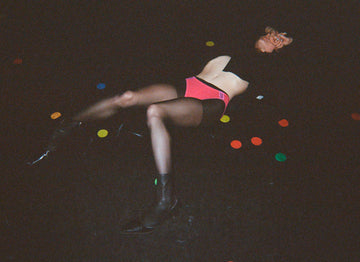


The 11th edition of Lingerie on Film is here with film by Joana Avillez, Julia Trotta, Julia von Boehm, Mina Stone, Miwa Susuda, Molly Rogers, Quinn Wilson, Sandeep Salter, Zoe Latta, and Nell Verlaque. On the occasion of the series release, we spoke to each contributor about their taste and perspective, pulling at the thread of what colors their lives. Our third to share is Patricia Iglesias Peco, a painter whose work is held in collections internationally and exhibited widely, most recently at François Ghebaly gallery.
Patricia Iglesias Peco grew up in Buenos Aires in the seventies, spending long stretches of her childhood at her grandmother's house — a place of total accumulation and freedom.
Jewelry, gowns, strange objects. Collages, crafts, embroidery. Her grandmother's world was kaleidoscopic, the opposite of the rigidity of home. In the background, always, her grandfather's records: the melancholic pull of tango. It is the kind of childhood that leaves a mark on the eye before the mind knows what to do with it.
Her father was born in Spain, and the family library held enormous books on Spanish painting. She remembers opening them and finding El Greco, the dark Baroque painters, lavish clothes and fruits and flowers spilling across the canvas. Her grandfather kept company with artists and writers; landscapes by Cerrito, Spilimbergo, and Soldi hung in his home. She was absorbing a visual education that had nothing to do with school and everything to do with rooms.

Explore all prints:
Shop Now-

$150
-

$150
-

$150


Painting was never a decision. There is a kindergarten book her mother kept in which she wrote that she wanted to be a painter when she grew up. "It was just something that came naturally," she says. "There was no starting date. I was just doing it and I guess I never stopped."
At fifteen she began studying ceramics and color with a Swiss sculptor who had been Lucio Fontana's mentor and friend. It shaped everything. "I approach my paintings as I would a sculpture," she says. "I literally carve with the brush — extracting and adding paint." The gesture in her work, its almost physical pressure, comes from there. Her paintings take on the language of still life and push it somewhere more unruly. The flowers that dominate her work are not beautiful flowers. "They are exploding, out of control, as if not being able to be contained," she says. "They are in an eternal state of metamorphosis and are monstrous. They have secret intentions — just like women."
The intellectual framework for this arrived during the pandemic, when she encountered an essay by Jamieson Webster on the long history that the sexual and the vegetal share in philosophic and psychoanalytic thought. Webster traced how flowers, like humans, release smells as a product of the breakdown process of sexual metabolism — signaling excitation, marking key stages of reproduction. Lacan entered: plants and flowers, he said in his seminar on mystical jouissance, were the pure pain of jouissance, the ecstasy of having your organs on the outside. Then Bataille's The Language of Flowers followed.
"I started seeing flowers in a different way," she says. "They no longer represented just a mere sign of beauty. Now they seemed to me aggressive, provocative, and in a state of arousal."
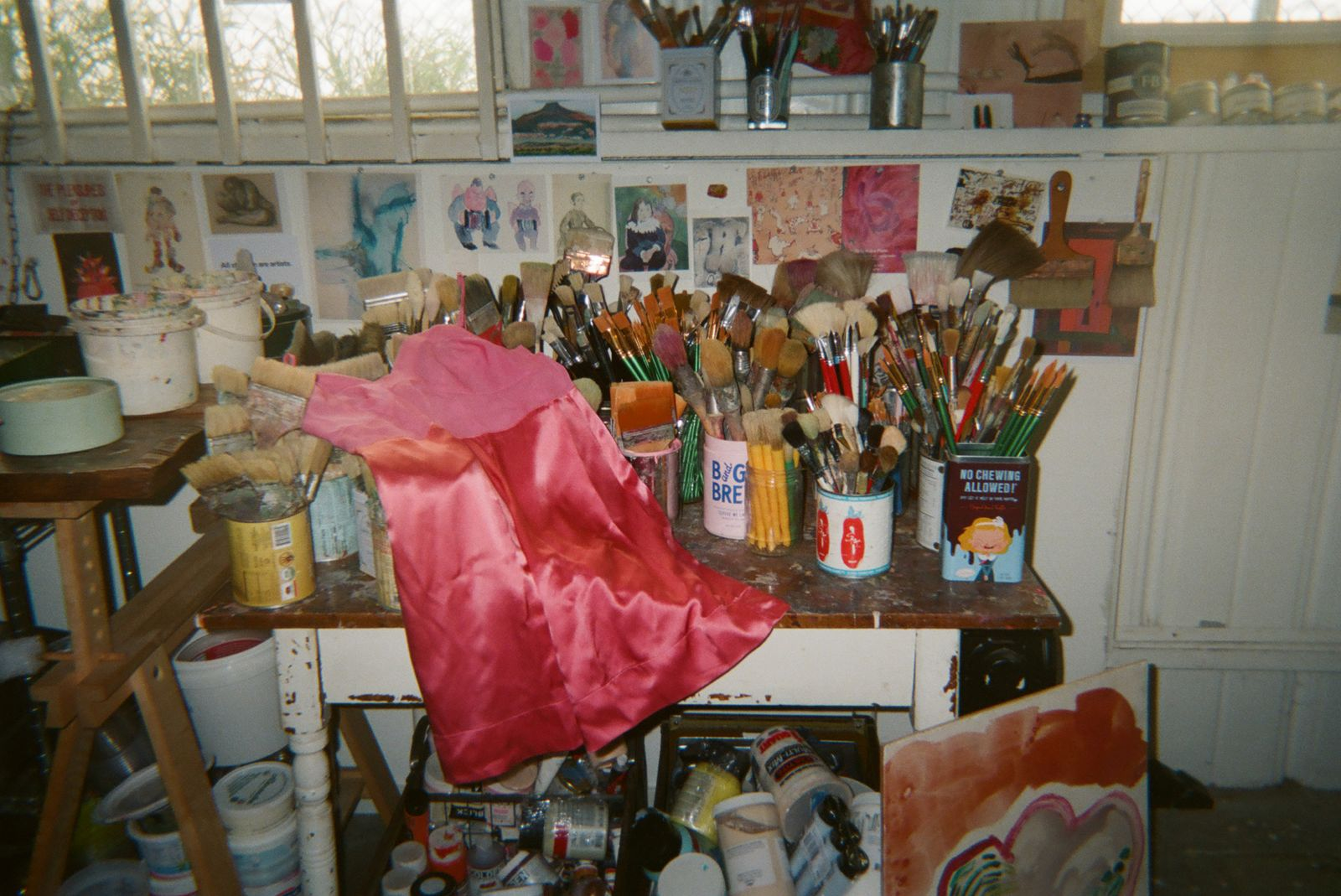
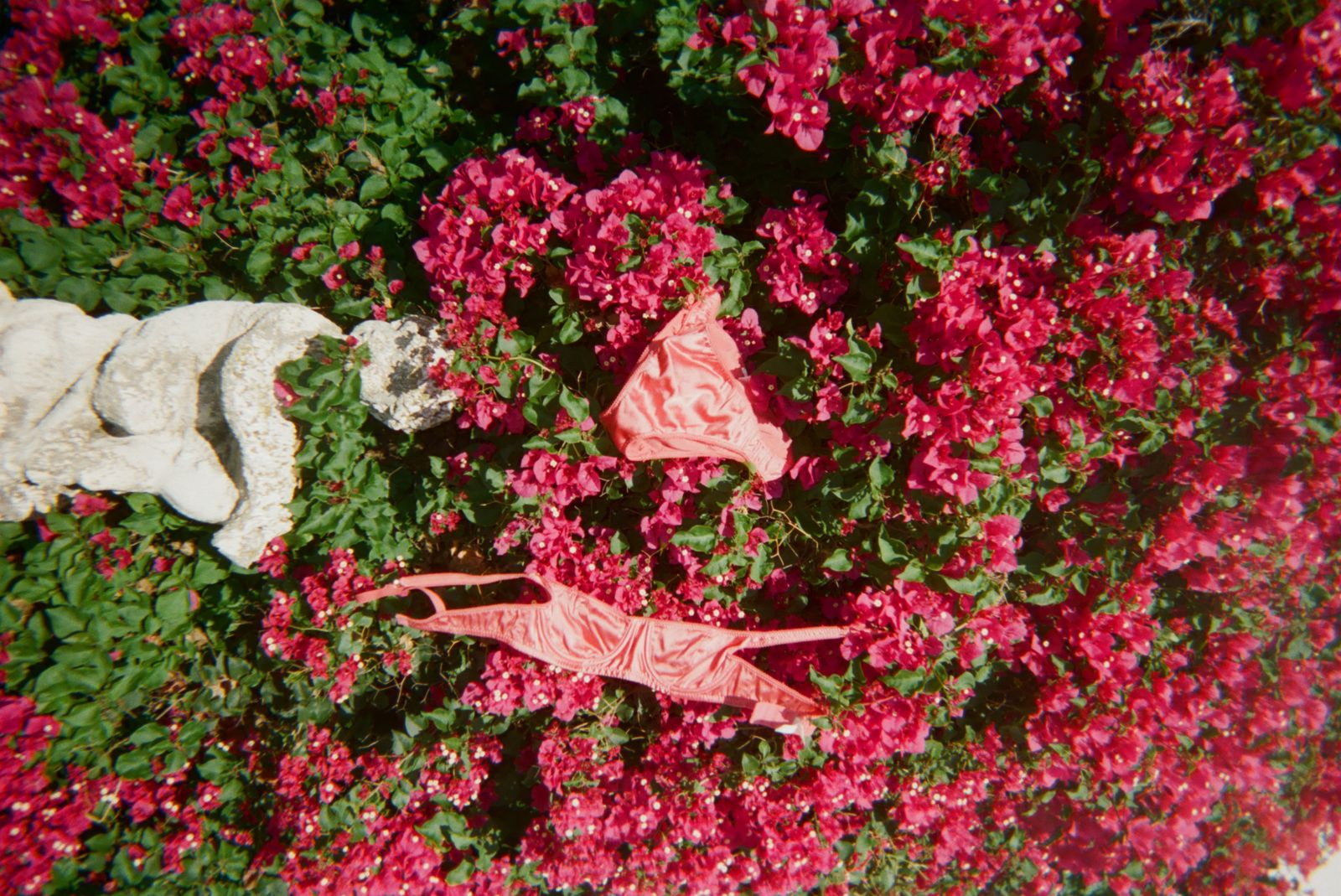
The Penelope Bralette in Rose, reconnecting with nature.
Patricia's studio right now is empty — blank canvases waiting, new work about to begin. She is looking at nature, gardens, ceramics. When she needs a creative reset she goes to the Huntington Garden in Pasadena, smuggles in a small set of watercolors, and sits beside the pond to play with color.
On weekdays she wears color underneath — Araks' bold palette worn close to the skin, hidden under clothes. On a Saturday night, it's a uniform of black.


It was in a small bookstore in Argentina, looking for more Clarice Lispector, that the final piece arrived. The owner, seeing she had already found everything available, recommended Marosa Di Giorgio — an Uruguayan poet known only in small literary circles, whose lyrical prose Peco describes as painting with words. "When I read her I felt an immense sense of belonging," she says. "Her work is absolutely visceral and raw. Her whole oeuvre is about flowers and this fantastical garden where animals, plants, and humans interact. Everything is fluid in her world. She dares to go to uncomfortable places with her work." It was, she says, a complete love at first read.
The writers she returns to consistently form their own kind of garden: Borges, Lispector, Di Giorgio, Marguerite Yourcenar, Cesar Aira. The artists are a longer and ever-growing list — Helen Frankenthaler, Eva Hesse, Vuillard, Bonnard, Fantin-Latour's flowers specifically ("insane," she says), and Matisse, always Matisse. Alongside them: Diana Cepleanu, Ida Barbarigo, Anna Zemankova, Eileen Agar, Leonor Fini, Cecily Brown, Ernesto Burgos, Domenico Gnoli, Carol Rama, Huguette Caland, Alice Neel, Joe Bradley, Jens Fange, Miriam Cahn, Elizabeth Glaessner, Florine Stettheimer, Odilon Redon, Gauguin, Mimi Lauter, Simon Fattal, Alice Mackler. The list, she notes, keeps growing.
Color is where she begins. She doesn't sketch. Instead she makes a chart of color at the start of each painting — "it's the color that guides the shape." She is drawn to palettes that make her uncomfortable, to combinations she finds ugly, because they force discovery. "I like tension in things," she says. "Color is such an incredible and powerful tool to create that." Harmony, for her, is not the goal. Friction is.


From Patricia's ouvre: Modern Nature XXI, 2023. Oil on board

"The Beatrice Bralette, Penelope Bralette and the Cadel Slip are perfection to me." Choosing from the entire collection is, she admits, “exactly like buying oil pastels at the art store.”
She just can't resist all those colors.
Explore the latest:
Shop Now-

$110
-

$110
-

$110
-

$110
-

$110
-

$145
-

$110
-

$110
-

$110
-

$130
-

$145
-

$110


